Filters
Question type

Which one of the following initiators can be used for free radical chain-growth polymerization?


A) benzoyl peroxide
B) CH3CH2CH2CH2Li\mathrm{CH}_{3} \mathrm{CH}_{2} \mathrm{CH}_{2} \mathrm{CH}_{2} \mathrm{Li}
C) BF3\mathrm{BF}_{3}
D) Al(CH2CH3) 3,TiCl4\mathrm{Al}\left(\mathrm{CH}_{2} \mathrm{CH}_{3}\right) _{3}, \mathrm{TiCl}_{4}

E) A) and C)
F) A) and B)

Correct Answer

verifed

verified

The acid-catalyzed dimerization of isobutylene gives a mixture of two isomeric alkenes (A and B\mathrm{B} ) . Hydrogenation of this mixture gives a single C8H18\mathrm{C}_{8} \mathrm{H}_{18} hydrocarbon. What is the hydrocarbon?  The acid-catalyzed dimerization of isobutylene gives a mixture of two isomeric alkenes (A and  \mathrm{B}  ) . Hydrogenation of this mixture gives a single  \mathrm{C}_{8} \mathrm{H}_{18}  hydrocarbon. What is the hydrocarbon?   A)  2,2,4-trimethylpentane B)  2,3,4-trimethylpentane C)  2,4-dimethylhexane D)  2,5-dimethyhexane


A) 2,2,4-trimethylpentane
B) 2,3,4-trimethylpentane
C) 2,4-dimethylhexane
D) 2,5-dimethyhexane

E) A) and B)
F) None of the above

Correct Answer

verifed

verified

A

Which one of the following initiators can be used for anionic chain-growth polymerization?


A) benzoyl peroxide
B) CH3CH2CH2CH2Li\mathrm{CH}_{3} \mathrm{CH}_{2} \mathrm{CH}_{2} \mathrm{CH}_{2} \mathrm{Li}
C) BF3\mathrm{BF}_{3}
D) Al(CH2CH3) 3,TiCl4\mathrm{Al}\left(\mathrm{CH}_{2} \mathrm{CH}_{3}\right) _{3}, \mathrm{TiCl}_{4}

E) B) and D)
F) B) and C)

Correct Answer

verifed

verified

B

Which one of the following monomers undergoes anionic polymerization most readily?  Which one of the following monomers undergoes anionic polymerization most readily?   A)   \mathrm{H}_{2} \mathrm{C}=\mathrm{CH}_{2}  B)   \mathrm{H}_{2} \mathrm{C}=\mathrm{CHCH}_{3}  C)   \mathrm{H}_{2} \mathrm{C}=\mathrm{C}\left(\mathrm{CH}_{3}\right) _{2}  D)   \mathrm{H}_{2} \mathrm{C}=\mathrm{CHCN}


A) H2C=CH2\mathrm{H}_{2} \mathrm{C}=\mathrm{CH}_{2}
B) H2C=CHCH3\mathrm{H}_{2} \mathrm{C}=\mathrm{CHCH}_{3}
C) H2C=C(CH3) 2\mathrm{H}_{2} \mathrm{C}=\mathrm{C}\left(\mathrm{CH}_{3}\right) _{2}
D) H2C=CHCN\mathrm{H}_{2} \mathrm{C}=\mathrm{CHCN}

E) A) and C)
F) All of the above

Correct Answer

verifed

verified

Which one of the following monomers undergoes cationic polymerization most readily?  Which one of the following monomers undergoes cationic polymerization most readily?   A)   \mathrm{H}_{2} \mathrm{C}=\mathrm{CH}_{2}  B)   \mathrm{H}_{2} \mathrm{C}=\mathrm{CHCH}_{3}  C)   \mathrm{H}_{2} \mathrm{C}=\mathrm{C}\left(\mathrm{CH}_{3}\right) _{2}  D)   \mathrm{H}_{2} \mathrm{C}=\mathrm{CHCN}


A) H2C=CH2\mathrm{H}_{2} \mathrm{C}=\mathrm{CH}_{2}
B) H2C=CHCH3\mathrm{H}_{2} \mathrm{C}=\mathrm{CHCH}_{3}
C) H2C=C(CH3) 2\mathrm{H}_{2} \mathrm{C}=\mathrm{C}\left(\mathrm{CH}_{3}\right) _{2}
D) H2C=CHCN\mathrm{H}_{2} \mathrm{C}=\mathrm{CHCN}

E) All of the above
F) None of the above

Correct Answer

verifed

verified

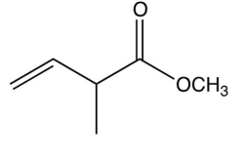
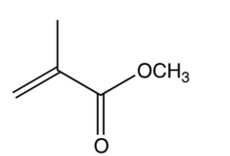
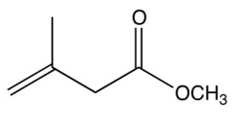
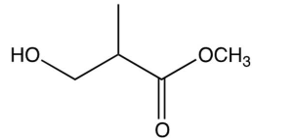
The repeating unit of poly (methyl methacrylate) is shown below. Which one of the following is the monomer used to make poly (methyl methacrylate) ?  The repeating unit of poly (methyl methacrylate)  is shown below. Which one of the following is the monomer used to make poly (methyl methacrylate) ?   A)     B)     C)     D)    <sub></sub>


A)
 The repeating unit of poly (methyl methacrylate)  is shown below. Which one of the following is the monomer used to make poly (methyl methacrylate) ?   A)     B)     C)     D)    <sub></sub>
B)
 The repeating unit of poly (methyl methacrylate)  is shown below. Which one of the following is the monomer used to make poly (methyl methacrylate) ?   A)     B)     C)     D)    <sub></sub>
C)
 The repeating unit of poly (methyl methacrylate)  is shown below. Which one of the following is the monomer used to make poly (methyl methacrylate) ?   A)     B)     C)     D)    <sub></sub>
D)
 The repeating unit of poly (methyl methacrylate)  is shown below. Which one of the following is the monomer used to make poly (methyl methacrylate) ?   A)     B)     C)     D)    <sub></sub>

E) A) and D)
F) A) and C)

Correct Answer

verifed

verified

Which one of the following is the monomer that gives the polymer shown below? Which one of the following is the monomer that gives the polymer shown below?   A)     B)     C)     D)


A)
Which one of the following is the monomer that gives the polymer shown below?   A)     B)     C)     D)
B)
Which one of the following is the monomer that gives the polymer shown below?   A)     B)     C)     D)
C)
Which one of the following is the monomer that gives the polymer shown below?   A)     B)     C)     D)
D)
Which one of the following is the monomer that gives the polymer shown below?   A)     B)     C)     D)

E) None of the above
F) B) and C)

Correct Answer

verifed

verified

Identify the repeating unit in the polymer formed from the following reaction sequence. Identify the repeating unit in the polymer formed from the following reaction sequence.   A)     B)     C)     D)


A)
Identify the repeating unit in the polymer formed from the following reaction sequence.   A)     B)     C)     D)
B)
Identify the repeating unit in the polymer formed from the following reaction sequence.   A)     B)     C)     D)
C)
Identify the repeating unit in the polymer formed from the following reaction sequence.   A)     B)     C)     D)
D)
Identify the repeating unit in the polymer formed from the following reaction sequence.   A)     B)     C)     D)

E) All of the above
F) A) and C)

Correct Answer

verifed

verified

Which one of the following initiators is used to make isotactic polypropylene?


A) benzoyl peroxide
B) CH3CH2CH2CH2Li\mathrm{CH}_{3} \mathrm{CH}_{2} \mathrm{CH}_{2} \mathrm{CH}_{2} \mathrm{Li}
C) BF3\mathrm{BF}_{3}
D) Al(CH2CH3) 3,TiCl4\mathrm{Al}\left(\mathrm{CH}_{2} \mathrm{CH}_{3}\right) _{3}, \mathrm{TiCl}_{4}

E) A) and C)
F) B) and C)

Correct Answer

verifed

verified

The monomer used to make superglue is shown below. Which one of the following methods of polymerization is most suitable for this type of monomer? The monomer used to make superglue is shown below. Which one of the following methods of polymerization is most suitable for this type of monomer?   A)  free-radical chain-growth B)  cationic chain-growth C)  anionic chain-growth D)  acid-catalyzed step-growth


A) free-radical chain-growth
B) cationic chain-growth
C) anionic chain-growth
D) acid-catalyzed step-growth

E) B) and C)
F) A) and D)

Correct Answer

verifed

verified

Which of the following is the monomer that gives the polymer shown below? Which of the following is the monomer that gives the polymer shown below?   A)     B)     C)     D)


A)
Which of the following is the monomer that gives the polymer shown below?   A)     B)     C)     D)
B)
Which of the following is the monomer that gives the polymer shown below?   A)     B)     C)     D)
C)
Which of the following is the monomer that gives the polymer shown below?   A)     B)     C)     D)
D)
Which of the following is the monomer that gives the polymer shown below?   A)     B)     C)     D)

E) All of the above
F) A) and B)

Correct Answer

verifed

verified

B

Which one of the following monomers is used to make the polymer carbowax, shown below? Which one of the following monomers is used to make the polymer carbowax, shown below?   A)    B)     C)     D)


A)
Which one of the following monomers is used to make the polymer carbowax, shown below?   A)    B)     C)     D)
B)
Which one of the following monomers is used to make the polymer carbowax, shown below?   A)    B)     C)     D)
C)
Which one of the following monomers is used to make the polymer carbowax, shown below?   A)    B)     C)     D)
D)
Which one of the following monomers is used to make the polymer carbowax, shown below?   A)    B)     C)     D)

E) A) and C)
F) A) and D)

Correct Answer

verifed

verified

Showing 1 - 12 of 12

Related Exams

Show Answer