Filters
Question type

Study Flashcards

Suppose 75.0 g of PCl5(g) is introduced into a 3.00 L vessel containing 10.0 g of Cl2(g) , and the system is allowed to reach equilibrium at 250ºC. PCl5(g) Suppose 75.0 g of PCl<sub>5</sub>(g)  is introduced into a 3.00 L vessel containing 10.0 g of Cl<sub>2</sub>(g) , and the system is allowed to reach equilibrium at 250ºC. PCl<sub>5</sub>(g)    PCl<sub>3</sub>(g)  + Cl<sub>2</sub>(g)  If K<sub>p</sub> = 1.80 for this reaction, what is the total pressure inside the vessel at equilibrium? (R = 0.08206 L • atm/K • mol)  A)  6.83 atm B)  8.86 atm C)  5.38 atm D)  3.47 atm E)  1.68atm PCl3(g) + Cl2(g) If Kp = 1.80 for this reaction, what is the total pressure inside the vessel at equilibrium? (R = 0.08206 L • atm/K • mol)


A) 6.83 atm
B) 8.86 atm
C) 5.38 atm
D) 3.47 atm
E) 1.68atm

F) A) and B)
G) B) and E)

Correct Answer

verifed

verified

Nitrogen dioxide decomposes according to the reaction 2NO2(g) Nitrogen dioxide decomposes according to the reaction 2NO<sub>2</sub>(g)    2NO(g)  + O<sub>2</sub>(g)  Where K<sub>P</sub> = 4.48 × 10<sup>-13</sup> at 25°C. What is the value for K<sub>c</sub>?(R = 0.08206 L • atm/K • mol)  A)  1.83 × 10<sup>-14</sup> B)  4.48 × 10<sup>-14</sup> C)  9.19 × 10<sup>-13</sup> D)  2.18 × 10<sup>-13</sup> E)  1.10 × 10<sup>-11</sup> 2NO(g) + O2(g) Where KP = 4.48 × 10⁻¹³ at 25°C. What is the value for Kc?(R = 0.08206 L • atm/K • mol)


A) 1.83 × 10⁻¹⁴
B) 4.48 × 10⁻¹⁴
C) 9.19 × 10⁻¹³
D) 2.18 × 10⁻¹³
E) 1.10 × 10⁻¹¹

F) A) and B)
G) None of the above

Correct Answer

verifed

verified

Which statement is correct?


A) If K < 1, lnK is negative, and ΔG° is negative then, the reaction is product favored.
B) If K > 1, lnK is negative, and ΔG° is positive, then the reaction is product favored.
C) If K > 1, lnK is positive, and ΔG° is negative, then the reaction is product favored.
D) If K > 1, lnK is negative, and ΔG° is negative, then the reaction is reactant favored.
E) If K < 1, lnK is positive, and ΔG° is positive, then the reaction is reactant favored.

F) A) and B)
G) C) and D)

Correct Answer

verifed

verified

A mixture of 0.500 mole of carbon monoxide and 0.400 mole of bromine was placed into a rigid 1.00-L container and the system was allowed to come to equilibrium. The equilibrium concentration of COBr2 was 0.233 M. What is Kc for this reaction? CO(g) + Br2(g) A mixture of 0.500 mole of carbon monoxide and 0.400 mole of bromine was placed into a rigid 1.00-L container and the system was allowed to come to equilibrium. The equilibrium concentration of COBr<sub>2</sub> was 0.233 M. What is K<sub>c</sub> for this reaction? CO(g)  + Br<sub>2</sub>(g)    COBr<sub>2</sub>(g)  A)  5.23 B)  2.14 C)  1.17 D)  0.467 E)  0.191 COBr2(g)


A) 5.23
B) 2.14
C) 1.17
D) 0.467
E) 0.191

F) All of the above
G) D) and E)

Correct Answer

verifed

verified

At 1500°C the equilibrium constant for the reaction CO(g) + 2H2(g) At 1500°C the equilibrium constant for the reaction CO(g)  + 2H<sub>2</sub>(g)    CH<sub>3</sub>OH(g)  has the value K<sub>P</sub> = 1.4 × 10<sup>-7</sup>. What is ΔG° for this reaction at 1500°C? (R = 8.314 J/K • mol)  A)  105 kJ/mol B)  1.07 kJ/mol C)  -233 kJ/mol D)  -105 kJ/mol E)  233 kJ/mol CH3OH(g) has the value KP = 1.4 × 10⁻⁷. What is ΔG° for this reaction at 1500°C? (R = 8.314 J/K • mol)


A) 105 kJ/mol
B) 1.07 kJ/mol
C) -233 kJ/mol
D) -105 kJ/mol
E) 233 kJ/mol

F) B) and D)
G) A) and E)

Correct Answer

verifed

verified

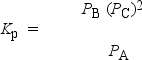
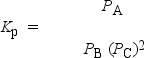
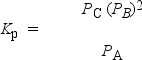
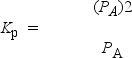
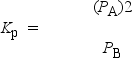
What is the expression for KP for the following reaction? A(g) What is the expression for K<sub>P</sub> for the following reaction? A(g)    B(g)  + 2C(g)  A)    B)    C)    D)    E)   B(g) + 2C(g)


A) What is the expression for K<sub>P</sub> for the following reaction? A(g)    B(g)  + 2C(g)  A)    B)    C)    D)    E)
B) What is the expression for K<sub>P</sub> for the following reaction? A(g)    B(g)  + 2C(g)  A)    B)    C)    D)    E)
C) What is the expression for K<sub>P</sub> for the following reaction? A(g)    B(g)  + 2C(g)  A)    B)    C)    D)    E)
D) What is the expression for K<sub>P</sub> for the following reaction? A(g)    B(g)  + 2C(g)  A)    B)    C)    D)    E)
E) What is the expression for K<sub>P</sub> for the following reaction? A(g)    B(g)  + 2C(g)  A)    B)    C)    D)    E)

F) A) and B)
G) All of the above

Correct Answer

verifed

verified

Showing 141 - 146 of 146

Related Exams

Show Answer